
What You See
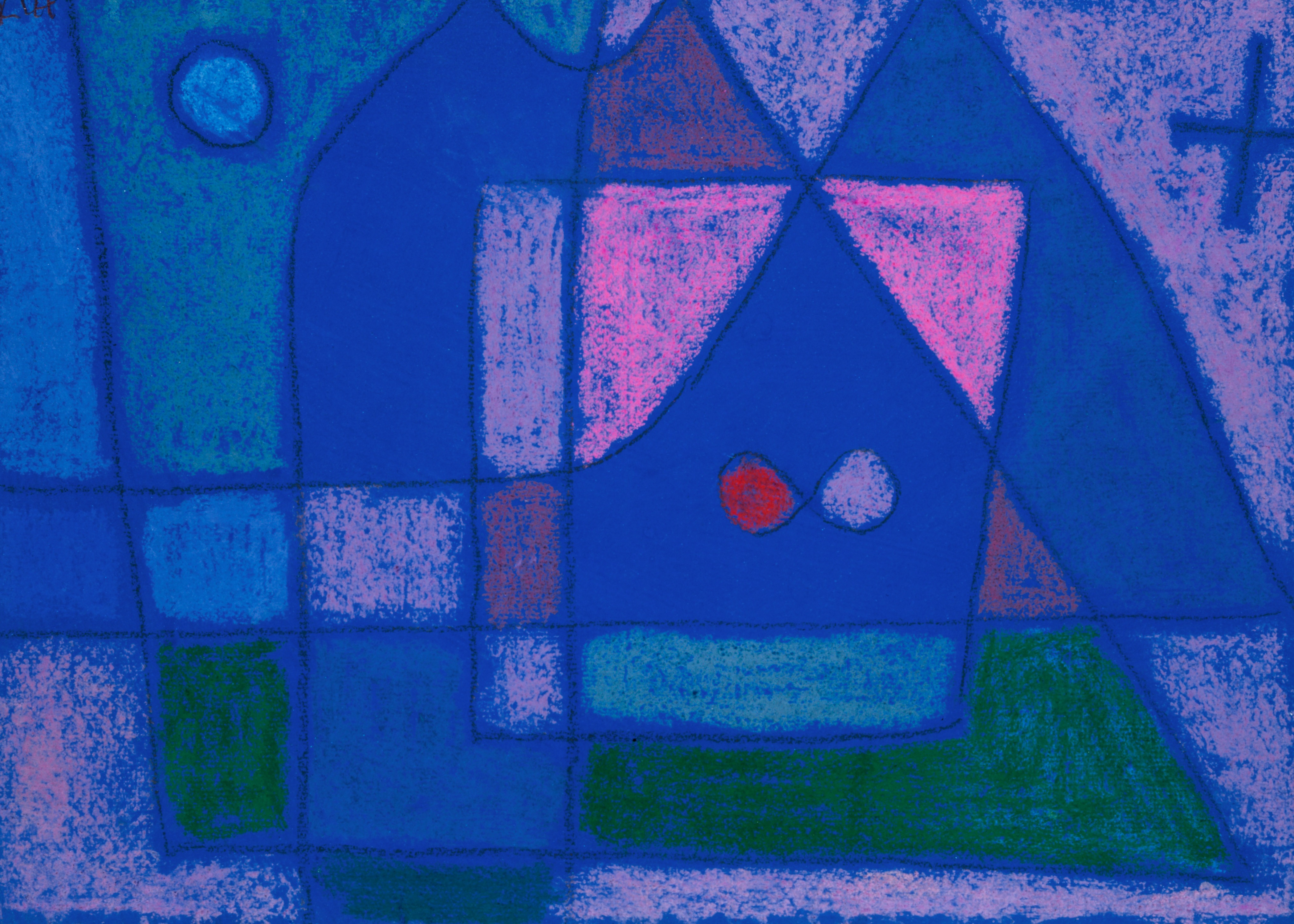
A night scene built from geometric shapes. Deep ultramarine blue dominates, broken by triangles of pink and lavender. Architectural forms suggest a roof, an archway, perhaps a boat. A pale blue circle floats in the upper left — moon or lamp. Two small dots of red and white glow like windows or distant lights. The colors are chalky, almost pastel despite their richness. It feels quiet, serene, dreamlike.
Context
1933, as Klee's world was narrowing. The Nazis had closed the Bauhaus and branded his work "degenerate." He would return to Switzerland the following year. Venice appears in the title (Ein Stübchen in Venedig) but not literally in the image — this is Venice remembered, abstracted, compressed into essential shapes and evening colors. The "little room" might be memory itself: a small, intimate space where place becomes feeling. This belongs to Klee's later, more somber period, blending Cubism and Surrealism into quiet meditation.
For Your Space
The dramatic blue palette makes a statement. This wants to be a focal point, not background. The landscape orientation suits spaces above sofas or beds. Evening colors mean it works especially well in rooms with warm artificial light — the blues will glow.