
What You See
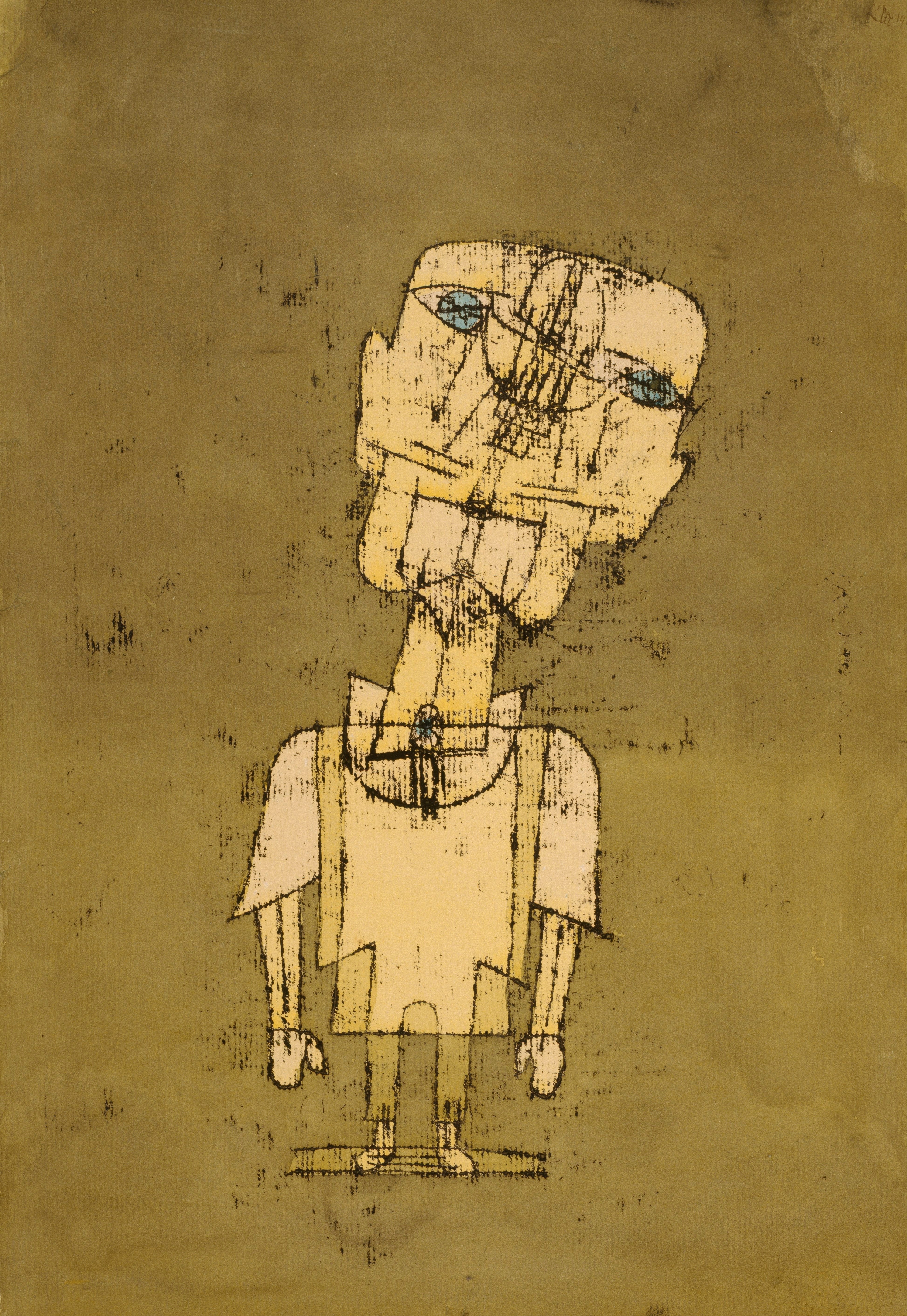
An oversized head hangs heavily on a tiny body. The figure stands awkward and still — arms flopping down, head tilted at an odd angle. Two bulging eyes stare out from a geometric face that's part human, part marionette. The olive-brown surface has the texture of aged paper, scratched and weathered. This wasn't painted in the traditional sense: Klee created it through oil transfer, drawing on the back of paper coated with paint, pressing like making a carbon copy. The result has a ghostly, smudged quality — appropriate for a specter.
Context
1922, during Klee's early years teaching at the Bauhaus. The German title Gespenst eines Genies carries a double meaning: "genius" here refers not to brilliance but to guardian spirits — the ancient Roman genii who watched over people and places. This is a portrait of a creative spirit, perhaps Klee's own, looking bewildered rather than brilliant. The puppet-like proportions aren't accidental — Klee made dozens of hand puppets for his son Felix, and those strange forms bled into his paintings. Some scholars see this as self-portrait: the domed head, close-cropped beard, and oversized eyes match photographs of Klee himself.
For Your Space
The muted palette makes this surprisingly easy to place. It reads as quirky without overwhelming — a conversation piece that rewards closer inspection. Works well in a study or creative space where visual wit is welcome. The portrait orientation suits narrow walls.