
What You See
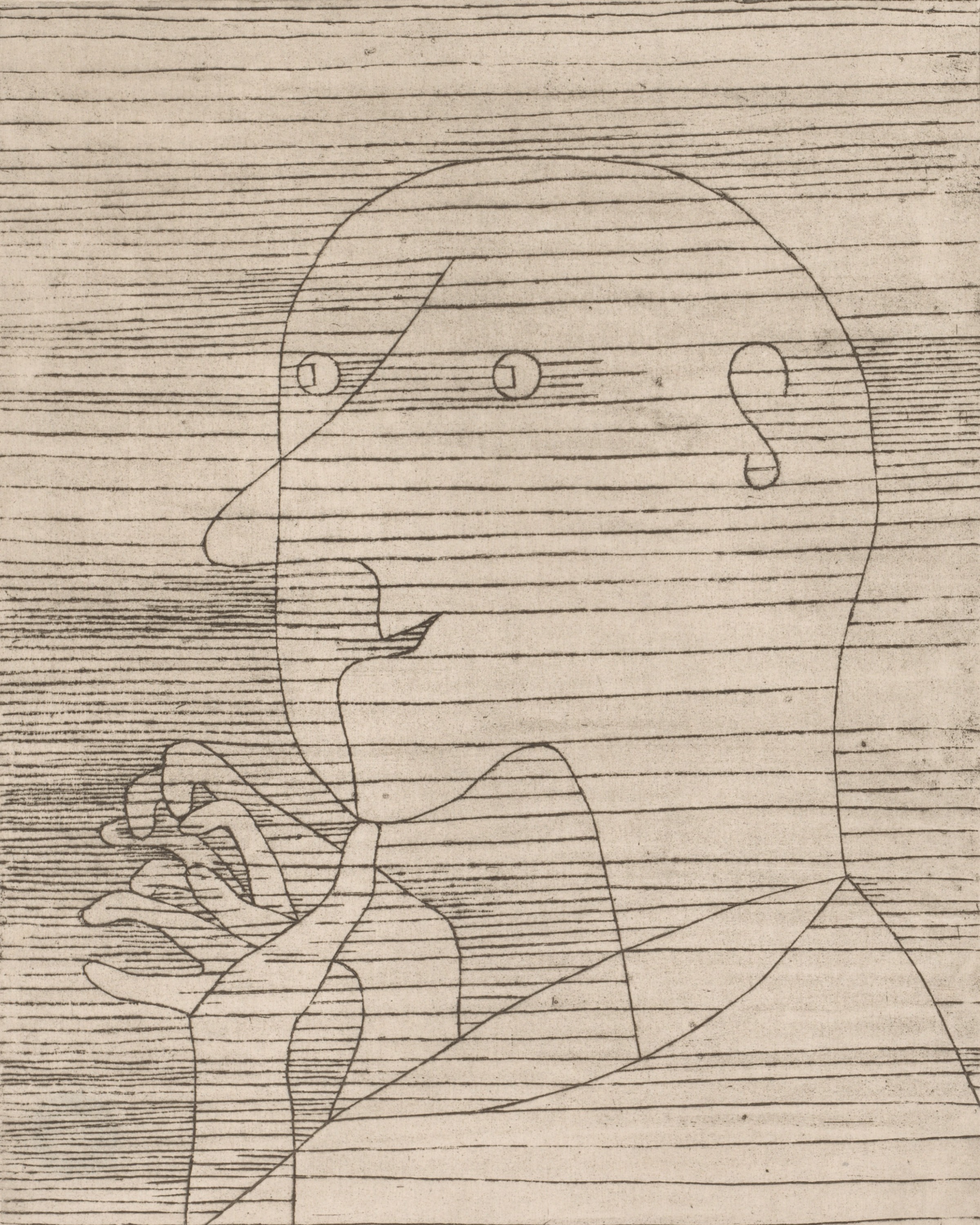
A face emerges from a field of horizontal lines. The lines run across the entire surface like ruled paper or television static. Within that pattern: a bald head, two small eyes, a nose, and one hand raised with fingers splayed — counting. The wavering, shaky lines convey age and concentration. The figure seems lost in thought, working something out. Extra marks around the hand suggest movement, the tremor of effort.
Context
1929, created as an etching — acid biting into metal plate to produce those characteristic wavering lines. The German title Rechnender Greis translates to "calculating" or "reckoning" old man. He's doing arithmetic, counting on his fingers like a child might, but with an old man's uncertainty. Klee captures something poignant here: the human attempt to make sense of the world through reason, even as faculties fade. Note: this is distinct from Klee's famous Senecio (1922), a colorful painted portrait often confused with this monochrome print.
For Your Space
The monochrome palette and print quality distinguish this from Klee's colorful paintings. It reads as graphic, almost contemporary in its restraint. Pairs well with other black-and-white works or provides contrast in a colorful room. The etching intimacy means it works best at smaller sizes.